Why four numbers, and who approves them
“We will recover as fast as possible” is not a plan — it is a hope. Recovery becomes manageable when it is expressed as targets: how long the business survives an outage (MTPD, or MAO), how fast a process must be restored (RTO), how much data may be lost (RPO), and what minimum level of service must be kept during recovery (MBCO). Process owners propose the numbers based on the Business Impact Analysis (BIA), finance checks them against the cost of downtime, executive management approves them, and the board sees the aggregate picture. The approved numbers then flow into architecture decisions, supplier SLAs and test plans.
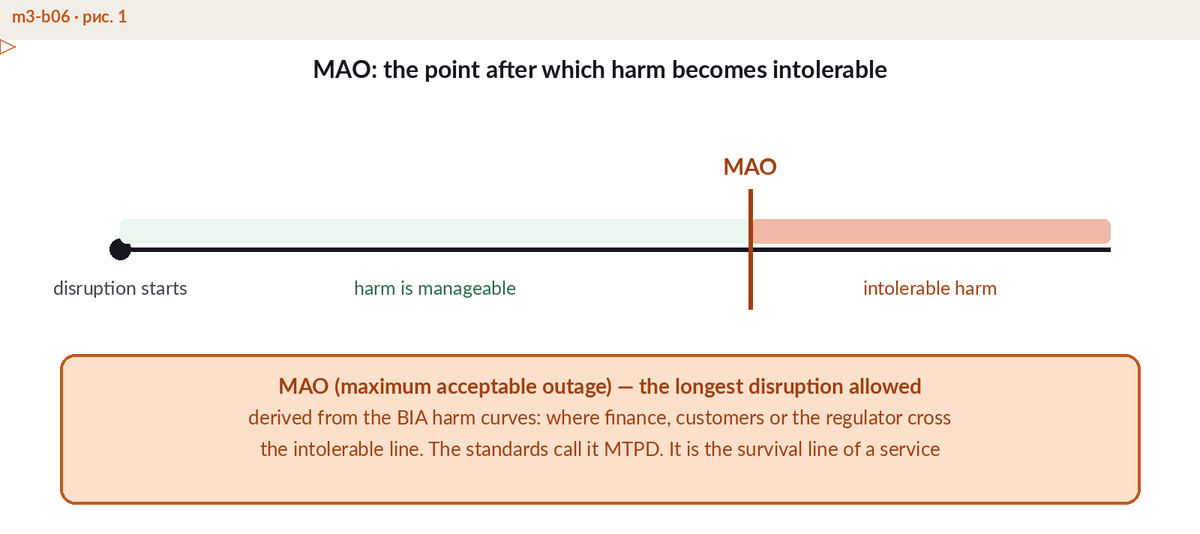
MAO: the boundary of the unacceptable
The Maximum Acceptable Outage is the longest a process can stand still before the damage becomes unacceptable: contract penalties, regulatory breach, patient safety, irreversible loss of clients. ISO 22301 calls the same boundary MTPD — the Maximum Tolerable Period of Disruption. Beyond this line you are no longer managing an incident; you are managing the survival of the business. The MAO comes from business analysis, not from IT: it reflects what customers, contracts and regulators will tolerate.
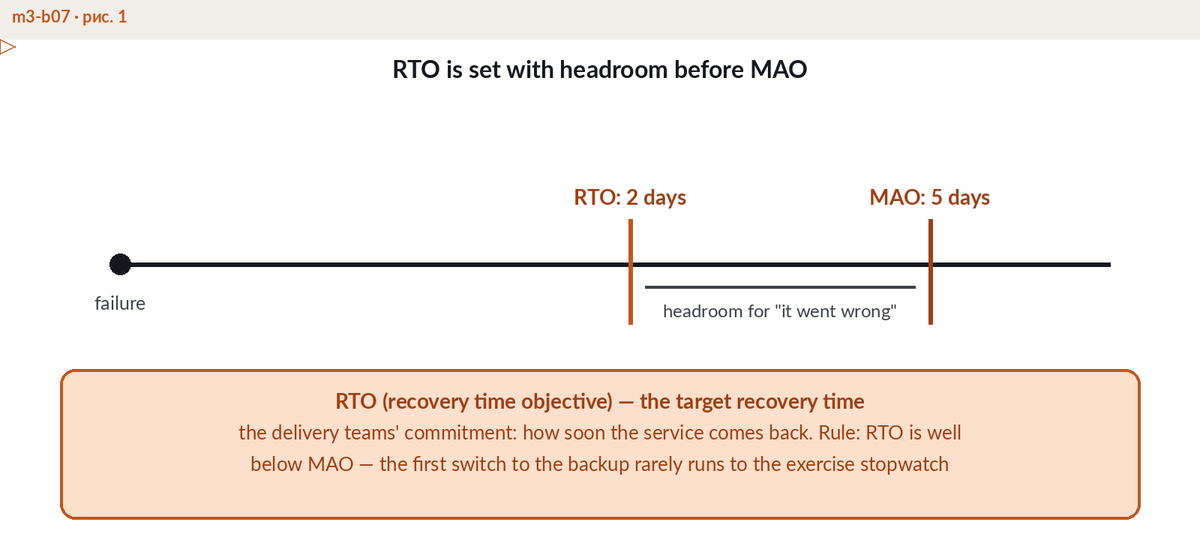
RTO: inside the MAO, with margin
The Recovery Time Objective is the target time to restore the process. It must sit inside the MAO with a margin, because real recoveries slip: a key person is unreachable, a step fails, a dependency surprises you. A margin of 30-50% of the MAO is a reasonable rule of thumb. Speed is bought, not declared — the shorter the RTO, the more expensive the standby architecture behind it, which is why an RTO is approved together with its price.
RPO: how much data you may lose
The Recovery Point Objective limits data loss, measured in time. An RPO of 5 minutes means the last usable copy of the data is never older than 5 minutes — which dictates replication or backup at least that frequent. RTO and RPO answer different questions: RTO is about when customers are served again, RPO is about how much of their data survived. And a backup that has never been restored in a test does not count as a backup.
MBCO: the minimum level of service
The Minimum Business Continuity Objective defines the level of service the company commits to deliver while recovery is under way — for example, 50% of normal throughput, priority customers first. Without an MBCO, recovery implicitly aims at 100% from the first minute, which inflates cost and blocks realistic decisions about what to restore first.
A worked example: a payment service
Consider a payment processor whose merchant contracts trigger penalties after 6 hours of outage, and whose clients begin switching providers after roughly a working day. The company sets the MAO at 6 hours. The RTO is set at 4 hours, leaving a 2-hour margin; the last failover test came in at 3 hours 10 minutes, so the chain holds — tested time under RTO, RTO under MAO. Replication to the standby site runs every 5 minutes, matching an approved RPO of 5 minutes. The MBCO states that during recovery the company keeps at least 50% of normal transaction throughput, with card authorisation prioritised over reporting services. Every number has an owner, an approval and a test behind it.
How the four numbers relate
| Objective | Question it answers | Example value |
|---|---|---|
| MAO (MTPD) | How long can we survive an outage? | 6 hours |
| RTO | How fast must the process be restored? | 4 hours (margin 2 hours) |
| RPO | How much data may we lose? | 5 minutes |
| MBCO | What minimum service do we keep meanwhile? | 50% of throughput |
Common mistakes
- Arbitrary round numbers — an RTO chosen without the cost of downtime is either ruinously expensive or uselessly slow.
- RTO equal to MAO, leaving zero margin for the slippage every real recovery has.
- An RPO promised on paper while backup restores are never tested.
- No MBCO, so every recovery aims at 100% at once.
- Targets set by IT alone, without the process owners who feel the business impact.
- Numbers never revisited after the business, its suppliers or its BIA change.
How these targets are derived from impact analysis — and what they cost — is the subject of module M3 of the ERGP programme. For the method itself, start with our guide to the Business Impact Analysis.
Download the template
Worksheet with MTPD, RTO, RPO and MBCO per activity next to tested recovery time and actual backup frequency, a gap column and the strategy to close each gap; a Definitions sheet. Xlsx.
Download xlsx (recovery-objectives-worksheet.xlsx)
Targets come from the BIA; facts come from the last exercise and the backup schedule. No registration, no forms. Need it adapted to your organisation or a full programme: see how we work.
Frequently asked questions
What is the difference between MBCO and MTPD?
MTPD (or MAO) is about time — how long the organisation can survive without the service before damage becomes unacceptable. MBCO is about level — the minimum volume of the service that must be kept or restored first. One caps the outage, the other defines the floor of delivery during it.
Is MTPD the same as MAO?
In substance, yes. MTPD is the ISO 22301 term, MAO appears in other frameworks; both name the boundary beyond which disruption is unacceptable. Pick one term for your programme and use it consistently.
In what order are the four numbers set?
From the impact analysis: first MAO/MTPD as the ceiling, then MBCO as the service floor, then RTO inside the ceiling with a margin, then RPO from the data-loss tolerance. Arrangements and budgets follow the numbers, never the other way round.
We audit your continuity system against AE/SCNS/NCEMA 7000 and ISO 22301, then raise the metrics that decide survival — with risk surveys, methodology and on-site training included where you need them.
How the audit works →