Workplace safety · Online · One shift
A safety programme written for site crews in the Gulf, in English and in Arabic, on the phone they already carry.
Most safety induction is written for the auditor and read by nobody. This one is written for the man on the scaffold and the driver in the yard, and ends with a named certificate.
The sample chapter is open — no form, no email.
The programme is taken by the crew. It is chosen and paid for by someone else, and that person has a different set of problems.
You have to show that induction happened, that it was understood, and that it covered what actually kills people on your sites. A signature sheet proves attendance, not understanding.
The main contractor asks for evidence of safety training before mobilisation. You need something defensible, fast, and possible for a crew that arrived last week.
You place people on sites you do not control. A worker who arrives already trained, with a certificate that can be checked, is worth more and is placed faster.
Three things are true of a Gulf site and untrue of the courses usually bought for it.
A course delivered only in English is understood by the supervisor and skimmed by everybody else. What is not understood is not applied, and the record of completion says nothing about that.
Imported material treats heat as a paragraph about drinking water. In this region it is a seasonal occupational hazard with its own rules, its own emergency and its own way of killing people who feel fine an hour earlier.
People arrive continuously and the annual training plan does not. A programme that needs a classroom, a trainer and a date will always be behind the actual composition of the crew.
SAFE was built against these three, in this order. Everything else on this page follows from them.
The fifth module carries the scenarios, the barriers, the permit types and the shift checklist of one sector — because a warehouse checklist read on a rig is ignored by the second line.
Falls from height, struck-by, trench collapse, temporary electrical supplies. Scaffold tags, exclusion zones under lifts, shoring regardless of how short the job is.
Loss of containment, fire and explosion, confined space, hydrogen sulphide. Isolation, gas testing, standby arrangements and the discipline around the permit.
Forklift and pedestrian separation, racking collapse, loading dock falls. Blind spots, height lines, wheel chocks and the rule against climbing racking.
One organisation can run more than one edition side by side — the certificate states which one was taken.
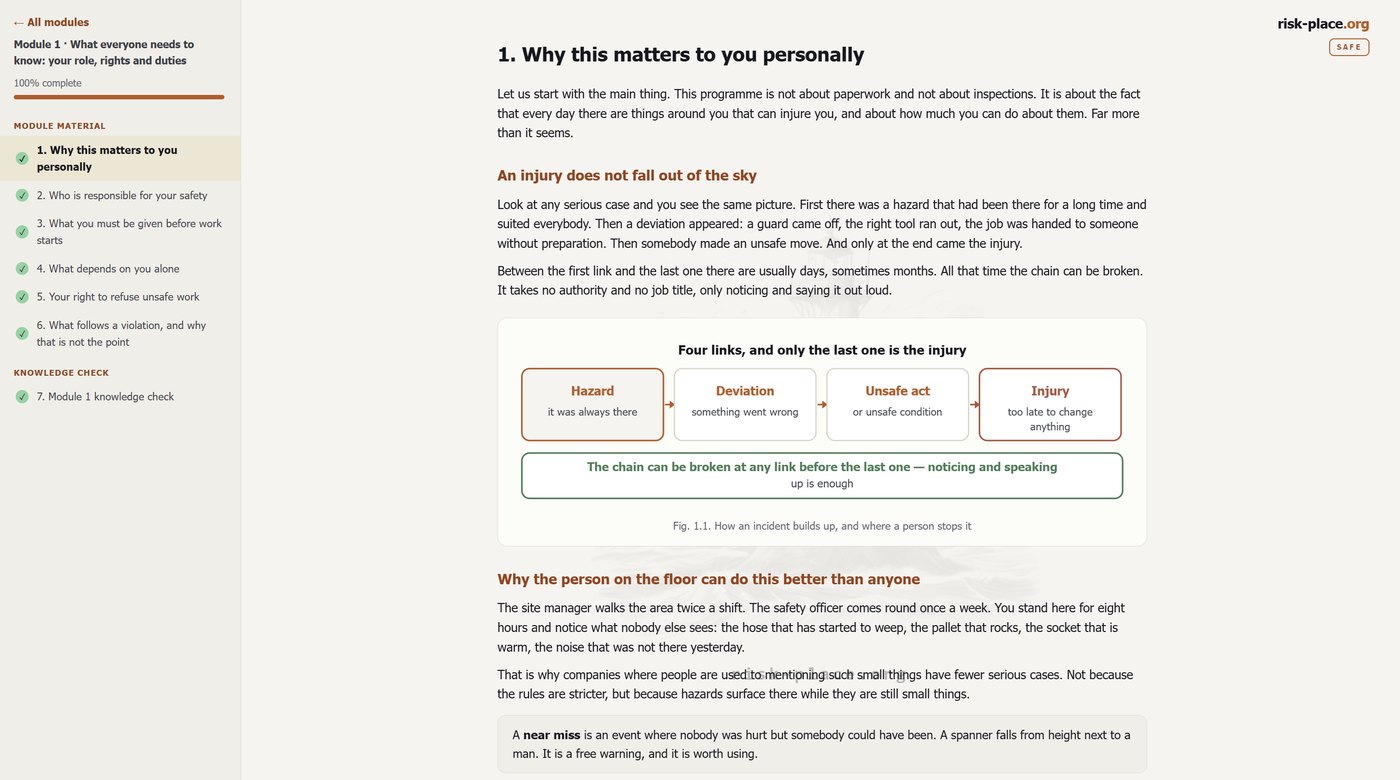
Each chapter is one screen of text, one diagram, one wrong-way / right-way comparison and one line the reader is meant to leave with. Nothing longer than a coffee break.
Your role, your rights, your duties. What the employer must provide before work starts, what depends on you alone, and the right to refuse unsafe work — stated plainly, because most crews have never been told it exists.
Ends with a knowledge check
The difference between a hazard and a risk, sizing up a risk in one minute, height and electricity, plant and vehicles, the slow hazards that bill you in twenty years, heat, and the hierarchy of controls.
Ends with a knowledge check
What culture actually means on a site, the incident pyramid, how to report a hazard so that it is heard, the right to stop work, and reviewing a case without hunting for someone to blame.
Ends with a knowledge check
The order that saves two people instead of one, what must never be done, first aid limits, heat exhaustion against heat stroke, the 48-hour notification rule, fire and near misses, and the worker's part in an investigation.
Ends with a knowledge check
Where irreversible harm happens most often in your sector, three severe scenarios with the barrier that stops each one, the Permit to Work, simultaneous operations, and a seven-point checklist for tomorrow's shift.
Ends with a knowledge check and the final assessment
Every summer the same thing happens on Gulf sites, and every year the training bought for it says almost nothing about it. SAFE gives heat a full chapter in the hazards module and a second one in the response module.
That heat takes judgement before it takes strength — a man becomes slower and less accurate an hour before he feels unwell, and he does not notice it in himself. That thirst arrives late, so drinking starts before it. That acclimatisation takes about two weeks and the newly arrived worker is the highest risk on the site. And that a colleague who has stopped sweating is not recovering.
The midday break calendar for the UAE, Saudi Arabia and Qatar with the actual dates and hours, the employer's obligations on shade, cooling, drinking water and salt replacement, and the distinction that decides a life: cool damp skin with a clear head is exhaustion; hot dry skin with confusion is heat stroke, and that is an emergency call, not a rest in the shade.
The Arabic edition is written, not machine-translated. Regulations carry their official Arabic names; designations such as ISO 45001 and OSHAD-SF stay as they are written in Arabic documents, so a supervisor can still find them.
Comprehension stops depending on the supervisor's willingness to translate. A crew of mixed nationalities gets the same content rather than a summary passed down the line. And the chapters that matter most — the right to stop work, the heat emergency, the 48-hour rule — are the ones most often lost in an informal translation.
The diagrams are identical in both editions, so a supervisor pointing at a figure is pointing at the same thing the worker sees. Completion records, test scores and certificates come to you in one consistent format regardless of which language the person studied in.
No stock photography of people in hard hats. This is the programme as it opens on a phone.
Works on any phone through the browser. Nothing to install, no account for the worker to create.
Two levels, and both of them resist the two things people do with online safety training: clicking through, and passing the answers around.
Each module ends in a short check on its own material. It opens only once every chapter of that module has been marked as read.
Fifteen situations across all five modules. Twelve correct to pass. It opens only after every module and every module check is complete.
Both the questions and the answer options are reordered on each attempt, so neither the sequence nor the position of the correct answer can be memorised or passed on.
No question asks what a term means. Every one describes something happening on a shift and asks what to do about it.
Attempts are unlimited. The point is that the crew ends up knowing this, not that somebody fails.
A knowledge check after every module and a final assessment at the end. The certificate follows a pass, not a login.
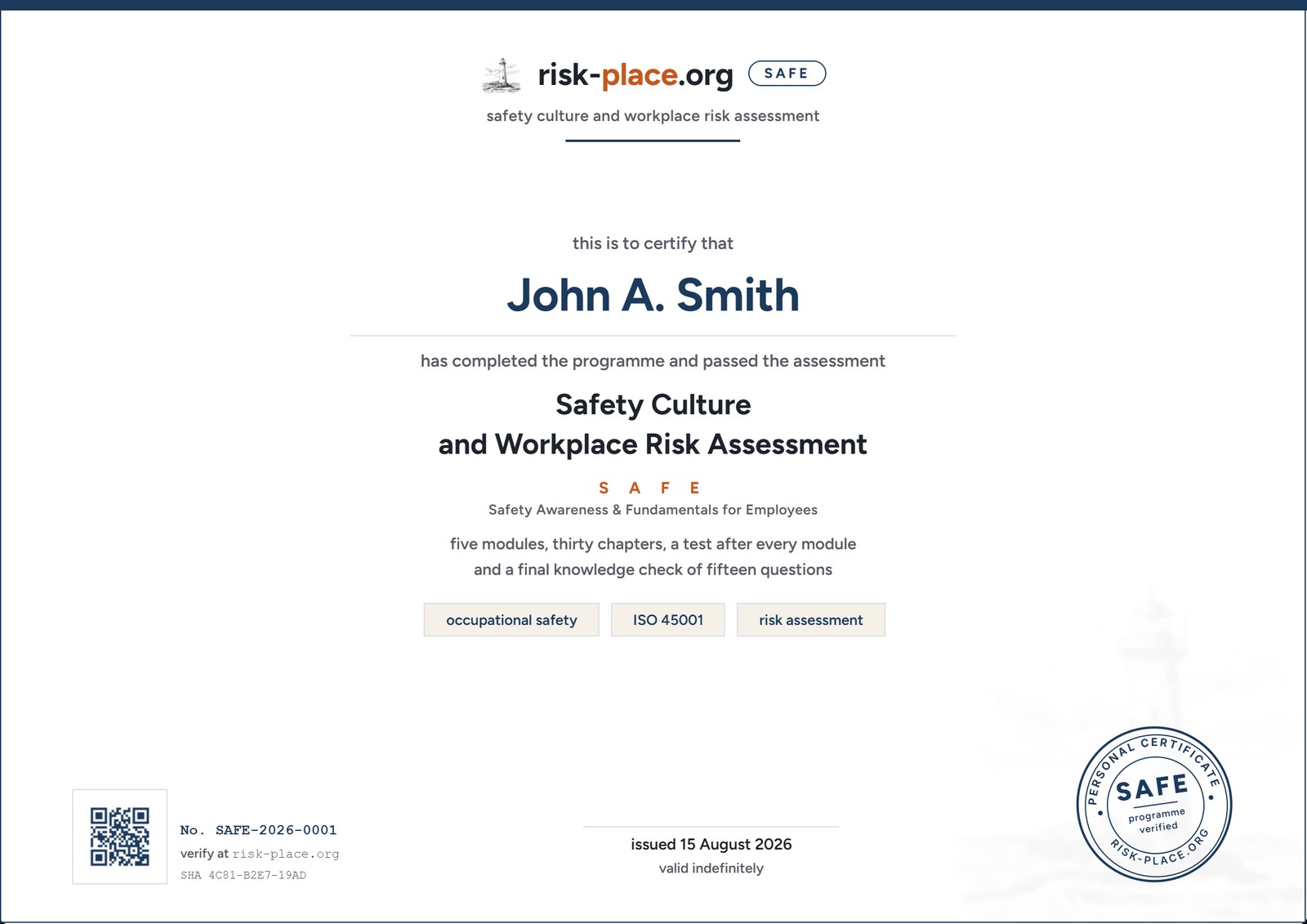
It carries the person's name, the industry edition taken and the date of issue. One worker, one document, no crew-wide printouts.
Every certificate carries a number. A main contractor asking what your crew has been through verifies it here in seconds.
Not a state accreditation and no substitute for a statutory qualification. We say so on the certificate itself — a document that overclaims fails at the moment it is checked.
The certificate: named, dated, numbered. Sample shown.
Enter the number printed on the certificate.
The programme is written against the international baseline and the practice of this region. Where a rule is local, the chapter says which rule and where it comes from.
| Source | What it covers in the programme |
|---|---|
| ISO 45001:2018 | Hazard identification and risk assessment, the hierarchy of controls, worker consultation, incident investigation, emergency preparedness |
| ILO C155 / R164 | The right to remove oneself from imminent and serious danger without detriment |
| OSHAD-SF | Abu Dhabi framework: documented risk assessment, permit systems, contractor management, incident reporting |
| Dubai Municipality HSE | Site safety plans, work at height, electrical isolation, fire safety requirements |
| Cabinet Resolution 33/2022 | Notification of work injuries and occupational diseases within 48 hours of the employer becoming aware |
| MOHRE midday break | Seasonal restriction on work in direct sun, shade and cooling provision, heat stress training and acclimatisation |
Dates and hours of the midday break are stated in the programme for the current season and reviewed each year. Where your jurisdiction differs from the UAE, the chapter shows the comparison rather than one country's rule.
Construction, oil and gas, or logistics. More than one if your workforce is mixed.
The programme is a single page. It sits on your server or on ours — your policy decides. No platform to license, no software to install.
Any phone, any browser. Progress is saved, so a man can stop at a break and continue after it.
Completions, test scores, certificate numbers. In whatever cadence you ask for.
Typical time from decision to a crew starting: two working days.
Per person, in either language, in the industry edition of your choice, with named certificates and completion records. Single access runs for six months and ends with the same certificate as the corporate route. From 500 people the rate is agreed on request; a site licence for one project for a year: from AED 35,000.
Tell us the industry and roughly how many people. A demonstration is a working link to the full programme, not slides about it; a request for access comes back with an invoice and the start date you name.
Around four hours of reading and answering. Most organisations run it across one shift, or split it over two or three breaks. Progress is saved, so stopping costs nothing.
No. The person opens a link, enters their name once for the certificate, and starts. Many site workers have no work email, and a programme that requires one does not get completed.
The page loads once and then runs from the phone. A weak signal on site does not interrupt someone halfway through a module.
Yes. It is a single file with nothing external in it. Put it on your intranet or your own server and it behaves identically.
It is a separate edition, written rather than translated, with regulations under their official Arabic names. The diagrams are common to both so that a supervisor and a worker are looking at the same figure.
Not by itself, and we will not claim otherwise. Where your jurisdiction requires certified training by an approved provider, this programme supports that obligation rather than replacing it. What it does give you is evidence that the content was worked through and assessed.
Yes — your rules, your permit forms, your emergency numbers and your muster points can be built into the fifth module. That is a separate piece of work and is quoted on its own.
The seasonal figures and the regulatory references are reviewed annually. Existing clients get the updated file.