A delivery vehicle waits outside a closed entrance. Inside, the production team is ready and the finished-goods store has stock. Nothing is wrong with the line, yet the site cannot receive or ship. That is the practical meaning of a single point of failure: one unavailable link decides the fate of the whole chain.
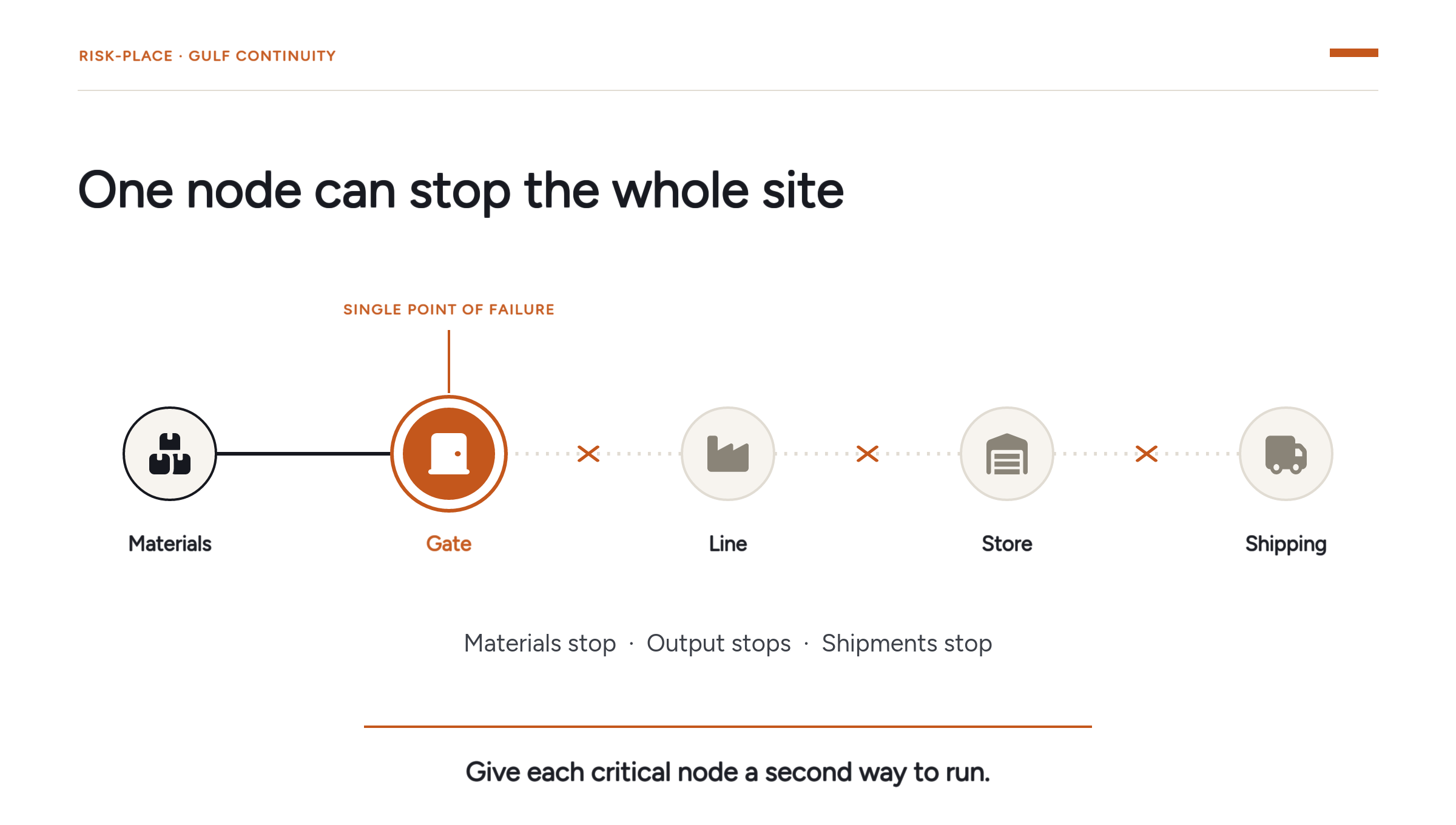
Walk beside one shipment
Start at the supplier and finish at the customer's receiving dock. At every handover, ask three questions: what happens here, what information is needed and who has authority to complete the step?
This walk often reveals dependencies that an asset register misses: a single loading window, one customs contact, a packaging specification known by one person, or the only system record that permits release.
Separate what can be bought from what must be designed
Standard materials, ordinary packaging, temporary labour and rented storage may have several market substitutes. The preparation here is commercial: qualified suppliers, current contacts and an agreed way to place an urgent order.
- Replaceable: a common input, a standard vehicle or an available warehouse.
- Unique: tooling, a controlled recipe, a specialist line or a customer-specific route.
- Human: a signature or decision that no deputy is authorised to give.
A unique dependency needs more than a purchasing list. It may need a second location, protected information or a formally assigned deputy.
Let the cost of interruption set priorities
Not every dependency deserves an expensive duplicate. Price one day of interruption at each critical point: missed shipments, continuing costs, contractual effects and the return to previous throughput.
Compare that exposure with the cost and speed of the alternative. Sometimes the best answer is inventory; sometimes a supplier agreement, a second gate or a short manual procedure offers more protection for less money.
A second route is real only when somebody uses it
Run a small rehearsal. Receive a practice delivery through the alternative entrance, call the reserve supplier or release a training shipment under the substitute authority. Measure the time and record every point where the team returns to the usual route for help.
A drone strike readiness check uses this site-level view to identify critical nodes, price their downtime and test whether the alternatives are genuinely available.
Questions owners ask
Does every critical resource need a duplicate?
No. Replaceable resources need reliable supply arrangements. Unique dependencies may need separation, duplication or a named deputy, depending on the exposure.
Why follow a shipment instead of listing equipment?
A shipment connects equipment with information, authority and logistics. It shows where the business result stops, not merely which asset is unavailable.
How do we know an alternative works?
Use it in a rehearsal. Record the time, output and any hidden return to the normal system, site or decision-maker.